
.avif)
A shipping container kitchen fails inspection for one of two reasons more than any other: a wall or ceiling finish that isn't smooth and cleanable, or moisture where it shouldn't be. Both trace back to the same decision — insulation for shipping container kitchens isn't a finishing detail, it's building science. Steel conducts heat and cold far faster than a stick-built wall, so an under-insulated container doesn't just run hot or cold — it sweats, and that condensation becomes rust, mold, and a failed inspection.
For a Director of Facilities specifying or approving a container kitchen, getting the R-value, material, and vapor-barrier spec right is what separates a code-compliant kitchen from a converted box. Here's what to verify before you sign off.
Why Insulation for Shipping Container Kitchens Is a Code Issue, Not Just a Comfort Issue
Insulation and its finish system aren't discretionary in a food-prep space — the FDA Food Code requires walls and ceilings to be smooth, durable, easily cleanable, and nonabsorbent where exposed to moisture. An assembly that traps condensation behind the wall fails that standard even if the finish looks fine on move-in day.
Most conversations about container insulation start and end with comfort: will the cooks be too hot or too cold. That's real, but it's not what shows up on an inspection report.
What the Food Code Actually Requires
Under the FDA Food Code (2022), section 6-101.11, indoor floor, wall, and ceiling surfaces must be:
- Smooth and durable — no rough textures or gaps where soil or bacteria can collect.
- Easily cleanable — surfaces must allow effective removal of soil through normal cleaning.
- Nonabsorbent wherever moisture is a factor — prep areas, warewashing, and walk-ins especially, since trapped water behind a wall is a food-safety issue, not a cosmetic one.
Why This Outlasts the Move-In Inspection
That requirement doesn't stop at the visible finish. A vapor-permeable assembly that lets moisture migrate into the wall cavity can pass inspection on day one and still fail once condensation has softened a substrate or fed mold behind a seam — the insulation and vapor-barrier system is what keeps the finish compliant over time, not just at delivery.
An inspector who finds bubbling, staining, or a soft spot will treat it as a violation, regardless of what the insulation behind it was rated for.
Note: Jurisdictions enforce the Food Code through their own adopted health code, so the exact citation number your inspector references may differ. The underlying requirement — smooth, durable, cleanable, nonabsorbent — is close to universal.

What R-Value Does a Shipping Container Kitchen Actually Need?
There's no single national R-value for a container kitchen — the requirement is set by the commercial energy code (IECC) adopted in your jurisdiction, and it varies by climate zone and by whether the assembly is framed in metal. A kitchen in a cold climate zone needs meaningfully more wall insulation than the same unit in a mild one.
How the Requirement Is Set
The Department of Energy's Building Energy Codes Program publishes the commercial envelope tables jurisdictions adopt locally. Two variables set your number:
- Climate zone — the requirement climbs step by step from warmest to coldest.
- Assembly type — metal-framed walls (the relevant type for a steel container) carry higher minimums than wood-framed walls.
For metal-framed walls, the prescriptive minimum climbs from roughly R-13 plus R-5 continuous insulation in the mildest zones to R-13 plus R-17.5 in the coldest. ENERGY STAR's climate-zone table shows a similar climb for ceilings, roughly doubling zone-to-zone.
.avif)
Tip: Don't treat a table like this one as your final spec. Pull the current table your Authority Having Jurisdiction (AHJ) enforces before signing a purchase order — the adopted energy-code edition varies by state and can lag the national version by several cycles.

Insulation Materials Compared: Spray Foam, Rigid Board, and Mineral Wool
Closed-cell spray foam is the default in steel-container construction because it bonds directly to the corrugated interior, closes condensation-causing air gaps, and acts as its own vapor barrier — but it's not the only option that can meet code, and each trades cost, labor, and finish compatibility differently.
Why Steel Changes the Math
Per Metal Construction News (2015), steel's thermal conductivity runs around 300 Btu·in./ft²·h·°F, against roughly 0.25–0.3 for common fibrous insulation — a gap large enough that any strategy must account for the framing itself conducting heat, not just the cavity between it.
The Three Common Options
1. Closed-cell spray foam — highest R-value per inch, adheres directly to corrugated steel, and functions as an integrated air and vapor barrier. Needs professional application and takes up more interior width.
%20(1)%20(1).avif)
2. Rigid foam board (polyiso or XPS) — lower-labor continuous insulation, but every joint needs sealing and taping, since a gap becomes a condensation line.

3. Mineral wool / fiberglass batt — DOE guidance puts cavity fiberglass at up to roughly R-15 to R-21 depending on cavity depth — workable, but not a vapor barrier on its own and weakest against thermal bridging without a separate continuous layer.
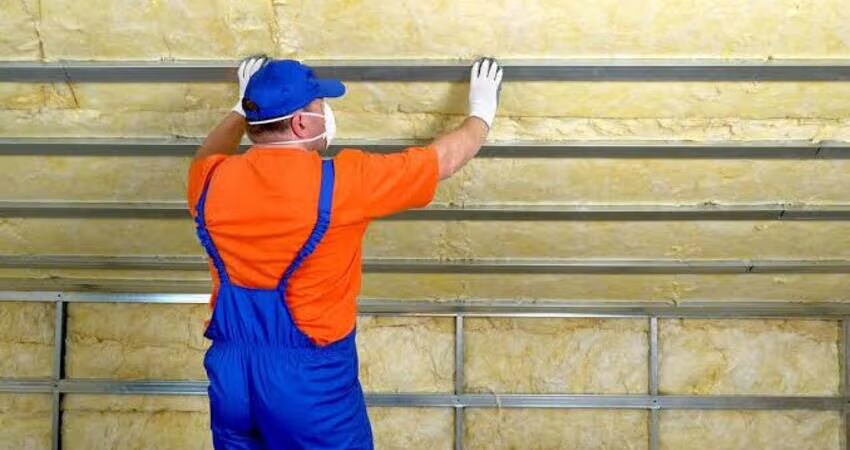
Note: A material's rated R-value assumes ideal installation. Compressed batts, gaps at penetrations, and uninsulated framing all reduce the effective R-value below the nominal rating — part of why factory-controlled installation matters more in steel than in wood framing.
Vapor Barriers and Condensation Control in a Steel Box
Direct answer: A vapor barrier's job is to keep humid interior air from reaching the cold steel shell before it condenses; get the barrier's permeability and placement wrong for your climate and you can trap moisture inside the wall even with adequate R-value.
How Condensation Forms
Condensation happens when warm, moist kitchen air meets a surface colder than its dew point. In a steel container, that cold surface is the shell itself unless insulation and a vapor barrier separate it from the interior.
Vapor Retarder Classes
The Insulation Institute classifies vapor retarders by permeability:
- Class I (0.1 perm or less, like polyethylene sheet) — tightest.
- Class II (kraft-faced batt, ~1.0 perm) — moderate.
- Class III (~1.0–10 perm, like standard latex paint) — loosest.
Getting Placement Right by Climate
- Cold, heating-dominated climates — the retarder generally belongs on the interior (warm) side.
- Hot, humid climates — that reverses, since a low-permeability interior barrier can trap moisture driven inward from outside.
- Closed-cell spray foam — sidesteps the placement question entirely, since it's insulation and vapor barrier in one layer.
Tip: If a container kitchen will operate in more than one climate over its service life — a relocatable unit moved between sites — flag that with whoever specs the insulation. A strategy tuned for one climate can be wrong for another.

How Insulation Affects Interior Space and Ceiling Height
Every insulation method costs interior volume, since it's added inside the container's fixed exterior dimensions rather than expanding the footprint — the tradeoff is real but manageable if it's accounted for at the design stage rather than discovered during equipment layout.
A standard container's interior height and width shrink once insulation, vapor barrier, and finish are added to the walls, floor, and ceiling — which matters directly to equipment clearances, ventilation runs, and code-required workspace. A kitchen designed against the container's raw dimensions, instead of its insulated interior dimensions, can end up short on clearance where it counts.
What to Verify Before Finalizing Layout
- Confirm finished interior dimensions — not raw container dimensions — before finalizing equipment placement or hood clearances.
- Ask whether a high-cube container is being used to offset the height lost to floor and ceiling insulation.
- Verify ventilation clearances against the insulated ceiling height, not the container's nominal rating.
How Modular Culinaire Specs and Installs Insulation
Off-site manufacturing means insulation and vapor-barrier installation happen under factory quality control and third-party inspection before the kitchen ever reaches your site — the same spec, verified the same way, every time, instead of depending on how carefully one crew installs it in the field.
Why This Removes a Coordination Point
For a Director of Facilities, insulation is rarely a trade you can supervise personally — it's one more sub inside an occupied-building project already coordinating plumbing, electrical, and ventilation. A factory-built modular kitchen removes that coordination point: insulation, vapor barrier, and MEP systems are pre-installed and inspected before delivery, so the spec you approve on paper is the one that gets built.
Answering the Comfort Objection
That also answers a common hesitation directly — that a container kitchen won't be comfortable for staff or won't hold up against moisture like a traditional kitchen. A properly specified, factory-installed system built to the same commercial energy code performs the same way, verified under controlled conditions rather than assumed correct after a field install.
Related Specs to Review
Insulation is usually one line item on a larger project. Worth reviewing alongside:
- Seismic requirements
- Electrical panel sizing
- The permitting path your project requires
Conclusion
Insulation on a shipping container kitchen is a code requirement, a moisture-control system, and a comfort factor, in that order of consequence. Getting the R-value, material, and vapor-barrier spec right before the unit is built is far cheaper than discovering a condensation problem after it's in service. If you're specifying or approving a container kitchen, talk to our team about the insulation and vapor-barrier package for your project's climate zone before the build is locked in.
Disclaimer
Energy-code R-value requirements and Food Code surface-characteristics rules are adopted and enforced locally, and the edition your jurisdiction has adopted may differ from the versions cited here. Confirm current requirements with your local building and health departments — specifically your Authority Having Jurisdiction for energy code and your local health inspector for food-code surface requirements — before finalizing an insulation spec.
People Also Ask (FAQ)
What R-value does a shipping container kitchen need?
It depends on your climate zone and the energy code edition your jurisdiction has adopted — there's no single national number. Metal-framed walls typically need continuous insulation added to cavity insulation, increasing in colder zones. Confirm the current table with your local building department before finalizing a spec.
Does a shipping container kitchen need a vapor barrier?
In most climates, yes. Steel conducts heat far faster than wood framing, so an uninsulated or poorly sealed container is prone to interior condensation. The right vapor-retarder class and placement depend on climate — interior side in cold climates, often exterior (or a self-sealing insulation type) in hot, humid ones.
Will insulating a shipping container kitchen reduce usable interior space?
Yes, to some degree. Insulation, a vapor barrier, and an interior finish all add thickness inside the container's fixed exterior dimensions, reducing interior width and ceiling height versus the raw container. Confirming finished interior dimensions before finalizing equipment layout avoids clearance surprises later.
What insulation material is best for a commercial kitchen inside a shipping container?
Closed-cell spray foam is the most common choice — it bonds to corrugated steel, closes air gaps, and serves as its own vapor barrier. Rigid foam board and mineral wool or fiberglass batt can also meet code but need a separately specified vapor barrier and careful installation to hit their rated performance.

.avif)

Tell us about your kitchen needs and request a quote.

Turnkey prefabricated kitchen
Proudly made in-house in the USA
Commercial grade kitchen equipment
Code-compliant
Trusted by Industry Leaders



