
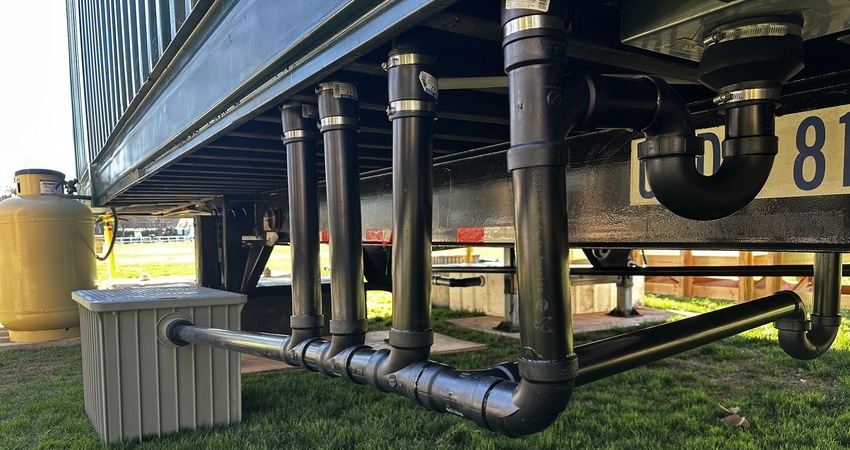
A grease interceptor that's sized wrong doesn't fail quietly. It fails in the plan reviewer's office, weeks before you wanted to be pouring concrete. Or it fails two years later, when grease carryover backs up a line the health inspector just walked past. Either way, the fix lands on whoever owns the physical plant.
This article is about the math and the code behind that number, not the maintenance routine around it. If you're specifically building out a relocatable kitchen, the sizing logic is the same but the installation sequence isn't: see Commercial Kitchen Plumbing: Rough-In Requirements for Container Builds and Grease Trap Requirements for Shipping Container Kitchens for that version. For the broader plumbing picture this sits inside, see Water & Plumbing: Commercial Kitchen Requirements.
Why Sizing Math Isn't Optional
An undersized interceptor doesn't just risk a fine. It risks:
- A rejected plan set. Most jurisdictions require the sizing calculation on the submitted drawings, not just the selected unit size. An incomplete or wrong calculation is a common reason plans bounce back.
- Grease passing straight through. Too little retention time, or a flow rate above what the unit is rated for, and grease never separates. It just rides the wastewater out.
- A re-engineered trade stack after construction starts. Catching an undersized interceptor once plumbing is roughed in means cutting back into finished work.
Note: The unit's rated flow rate (gallons per minute) and its rated capacity (total gallons) are two different numbers. A correctly sized interceptor satisfies both: undersized on either one and the unit fails its intended purpose even if the other number looks fine.
The Variables Every Formula Uses
Every sizing method, regardless of jurisdiction, works from some combination of the same inputs:
%20(1).avif)
Flow Rate
This is the number inspectors come back to first. A dishwasher, a pot sink, and a disposer unit don't discharge at the same rate, and a formula that treats them as equal will undersize the unit.
Retention Time
Grease needs time suspended in the interceptor to rise and separate before the water moves on. Shorter retention windows require either a larger tank or a lower flow rate reaching it. The two variables trade off against each other.

Three Sizing Methodologies in Use (And Why They Disagree)
There is no single national formula. Three distinct methodologies show up across US jurisdictions, and a kitchen operating in more than one state will run into more than one of them.
1. Fixture-Unit (DFU) Method
Each fixture connected to the interceptor is assigned a fixture-unit value, and the sum determines the required flow rate and interceptor size. Pinole, California's adopted plumbing code ties this directly to a flow-rate ceiling: the total DFUs of fixtures discharging into a hydromechanical grease interceptor can't exceed two and one-half times the unit's certified GPM rating, codified under its §1011.0 Grease Traps and §1012.0 Grease Interceptors for Commercial Kitchens sections (Pinole Municipal Code).
2. UPC Appendix H: Meals-Per-Peak-Hour Method
Built around throughput rather than fixtures: seating capacity and establishment type set a meals-per-peak-hour figure, which is then run through waste flow rate, retention time, and a storage factor to reach a final gallon capacity. Carmel, Indiana cites this directly as the Uniform Plumbing Code Appendix H method (City of Carmel calculation sheet), and both the Texas Commission on Environmental Quality (statewide worksheet) and the City of Southlake, TX (local worksheet) use the identical six-step structure.
3. Flow-Rate / Fixture-Rating (Manning) Method
Assigns a grease-laden-waste rating to each fixture type, multiplies by a GPM figure derived from the Manning formula, adds direct dishwasher/can-wash/mop-sink flow, then applies a 30-minute retention time and a peak flow ratio reflecting an 8-hour business day against a 24-hour cycle. The Town of Amherst, NY documents this approach by name (Grease Interceptor Sizing Criteria).
%20(1).avif)
Tip: Confirm which method your authority having jurisdiction (AHJ) has adopted before a design proceeds. The three methods can produce meaningfully different gallon totals for the same kitchen.
%20(1).avif)
How Jurisdictions Differ on Minimums
Even within one methodology, local amendments move the floor:
- Fort Worth, TX requires sizing calculations on submitted plans and sets a documented minimum, with no interceptor below 500 gallons accepted under any circumstance (City of Fort Worth guidance).
- The same Fort Worth standard routes any result under 750 gallons through an alternate review path rather than auto-approving it.
- Documentation requirements vary too: several jurisdictions require the calculation itself, not just the final unit size, to appear on the stamped plan set.
Note: None of this is optional reading for a different state. If your portfolio spans jurisdictions, confirm the adopted method and minimum locally. Don't carry one city's number to the next project.

A Worked Example (UPC Appendix H Method)
Using the TCEQ/Southlake structure for a 120-seat full-service restaurant kitchen running a 12-hour day, with a dishwasher:
%20(1).avif)
That 2,700-gallon result is before any local minimum or AHJ adjustment. The worksheet gets you to a defensible starting number, not a final answer the plan reviewer can't question.
Where This Fits Into a Modular Build
The calculation doesn't change based on how the kitchen is built; a modular kitchen needs the same math a traditional build does. What changes is when the number has to be locked in. In a factory-built kitchen, drain-waste-vent runs and stub-outs are fabricated before the unit ships, which means the interceptor sizing decision has to be settled at the design stage, not worked out on-site as conditions reveal themselves. A single turnkey partner coordinating that calculation alongside the rest of the MEP scope, rather than a separate plumbing sub pulling numbers together mid-construction, is one of the places a prefabricated build saves the back-and-forth a traditional project absorbs.
Common Mistakes Directors of Facilities Catch Too Late
- Sizing off the fixture list from an early menu concept that changed before final equipment selection
- Treating a dishwasher's rated flow as optional to include, rather than a required direct-flow input
- Using a neighboring jurisdiction's minimum size as a stand-in for the actual AHJ's requirement
- Submitting the selected unit size without the calculation sheet behind it
People Also Ask (FAQ)
What size grease interceptor does a commercial kitchen need?
It depends on the adopted method and jurisdiction; there's no single number. A small full-service kitchen might land anywhere from 500 to several thousand gallons depending on seating, fixture count, and the local formula.
Is a grease trap the same as a grease interceptor?
The terms are often used interchangeably in code text, though "grease trap" more often refers to smaller, indoor hydromechanical units and "grease interceptor" to larger, typically exterior gravity units with longer retention times.
Who calculates grease interceptor sizing?
Several jurisdictions specify this be performed or stamped by a licensed engineer or plumber, and require the calculation sheet, not just the final size, submitted with the plan set.
.avif)

Tell us about your kitchen needs and request a quote.

Turnkey prefabricated kitchen
Proudly made in-house in the USA
Commercial grade kitchen equipment
Code-compliant
Trusted by Industry Leaders



