If you run a community you don't own, a senior living kitchen capital budget isn't really your decision. It's your pitch, defended to a corporate capital committee or a REIT owner who never walked your line, and an open-ended, contractor-driven timeline is a hard sell to someone who wasn't in the room.
Here's where that money actually goes, what a cheaper bid tends to hide, and how to compare two kitchen quotes the way your committee will.
Why the Capital Case Looks Different When You Don't Own the Building
On a managed or REIT-owned community, you're building a business case for people who control the capital but not the kitchen. You own the P&L, occupancy, and licensing compliance, but sign-off sits one level up, with a committee that judges the project on schedule and budget discipline alone.
A country club GM defending a project to a resident-elected board at least sits across from people who've eaten in the dining room. A senior living GM or Executive Director on a managed property often defends the same project on paper, weighed against the next community in the portfolio asking for money.
A Real Example: Centralized Capital at Welltower
Welltower's capital-allocation team shows the pattern in practice: in early 2025, its centralized team had renovated or started renovating 90 senior living employee break rooms across operating partners, a decision made at the ownership level, not community by community (Senior Housing News, 2025).
Note: if your kitchen is competing for that same centralized pool as break rooms and unit refreshes, your number has to hold up next to all of them.
Where the Capital Committee's Money Actually Goes
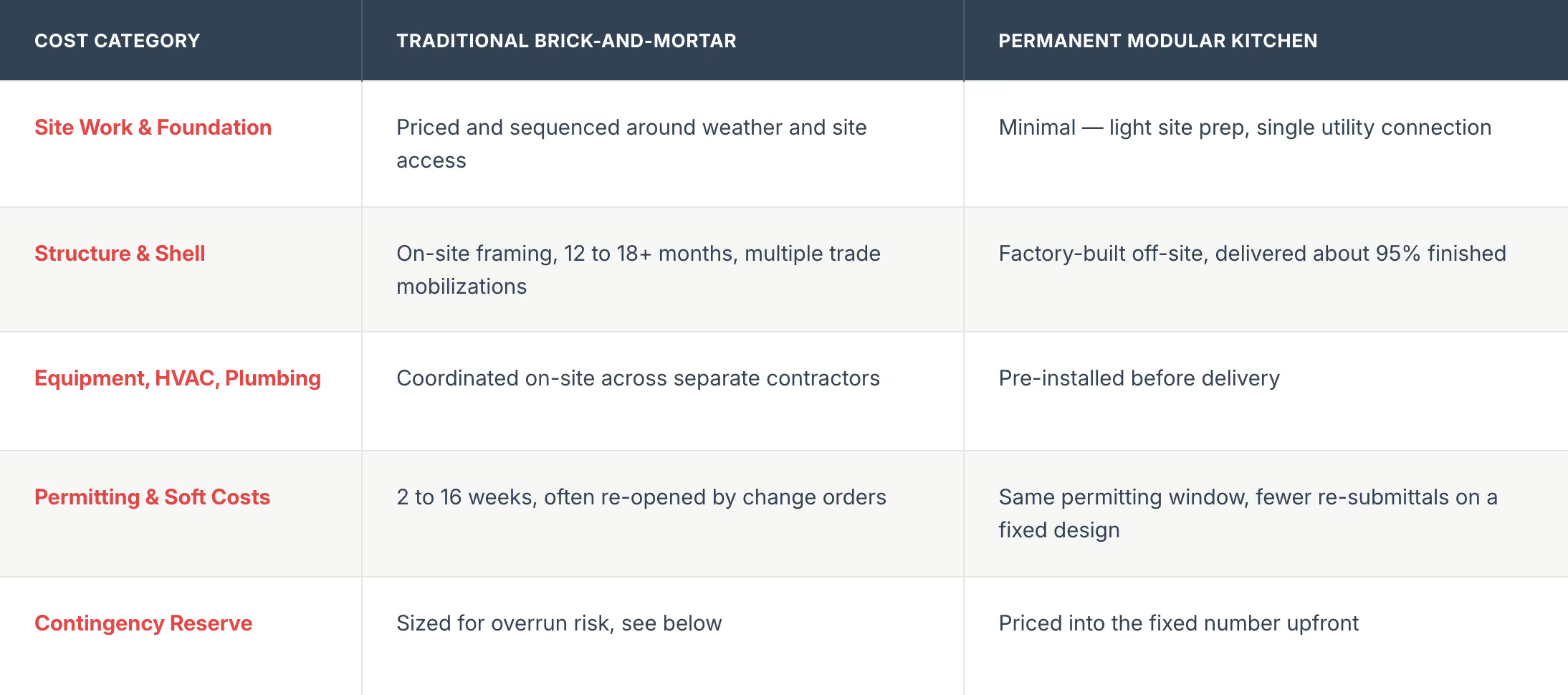
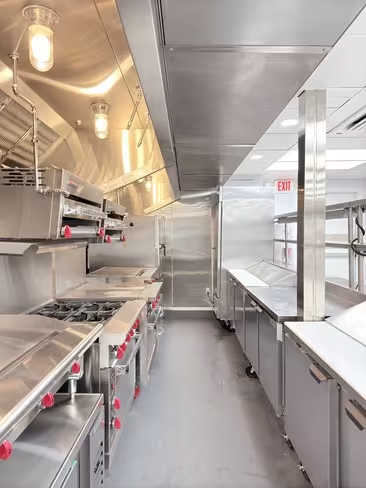
A capital committee rarely asks what a kitchen "costs." It asks what's in it: site work, structure, equipment and MEP, permitting, and a contingency reserve sized for overrun risk. Walking the committee through each line, traditional versus modular, puts the conversation on its own terms instead of a contractor's.
The Line-Item Breakdown
What the Cross-Vertical Numbers Do (and Don't) Prove
Modular Culinaire's own figures come from two cross-vertical case studies, Apogee Golf (a private golf club) and Boyne Resorts (a ski resort group), which saved roughly 20% and 30% against traditional construction. Neither is a senior living project, and no senior-living-specific savings figure exists yet. Treat both numbers as directional evidence, not a figure to promise your committee.
The Line Items That Move the Total Most
Three things move a kitchen budget more than anything in the table above: change orders triggered mid-build, schedule slippage that compounds into lost dining revenue, and coordination gaps between trades that turn into rework. A committee has usually been burned by all three before, which is why a fixed-price number earns more trust than a thinly-reserved bid.
- Change orders: Scope changes are the largest single driver of overrun once construction starts: equipment substitutions, code findings, and design gaps become premium-priced change orders instead of pre-build decisions.
- Schedule slippage: A delayed opening is not a soft cost. Every week of delay is a week of carrying cost and lost dining revenue with nothing coming in against it.
- Coordination gaps: More trades on one site means more handoffs, and more handoffs mean more rework billed back to the project.
A fixed-price, factory-built kitchen prices these risks in before the committee sees the number, instead of leaving them as a contingency line it has to take on faith. Our breakdown of commercial kitchen change orders covers the first point in detail.
Tip: separate "priced-in risk" from "hoped-for luck" in the budget you present. A committee that has watched a project run over on hope trusts a number with the risk priced in upfront.
What the Cheaper Bid Often Leaves Out
A lower number on paper usually means a smaller contingency reserve, not a more efficient build. Large construction projects overrun budget by an average of 79% and schedule by 52%, per a 2022 McKinsey & Company analysis of 500+ global projects (Engineering News, 2026). That's exactly what a committee remembers about the last kitchen.
The cost of a slipped opening is sharper now than it has been in years. National occupancy crossed 90% in the third quarter of 2026 for the first time since before the 2008 financial crisis, with new construction running at roughly a tenth of what demand requires (IREI, 2026). In a market this tight, a delayed kitchen is a reputation risk during the exact window when families are comparing you to a community that isn't mid-renovation.

How to Compare a Modular Quote to a Traditional Bid
Put the two bids side by side on three things: price structure, schedule, and depreciation treatment, not the headline number alone. A fixed price versus a guaranteed maximum, a parallel-build schedule versus a sequential one, and a factory depreciation schedule versus a site-built one each tell the committee something the total hides.
Three Lines to Put Side by Side
- Price structure: A fixed price versus a guaranteed maximum with a contingency allowance that may or may not get spent, but gets billed to you either way if it isn't.
- Schedule: Modular construction runs in parallel with site prep, cutting up to 50% off a traditional timeline, so the committee gets a date instead of a range.
- Depreciation treatment: A factory-built kitchen can carry a more favorable depreciation schedule than a site-built one. Our guide to modular kitchen depreciation covers the mechanics; read it before your finance team asks.
The Before-and-After Standard Owners Already Expect
Brookdale's asset-management team tracks this kind of post-renovation ROI on every project it reviews (Senior Housing News, 2026), and one Florida community posted a 128.6% ROI after a $654,000 renovation, occupancy up 5 points (RMR Group, 2026). Bring that same before-and-after framing to your own request.
If a Full Replacement Doesn't Fit Your Phasing
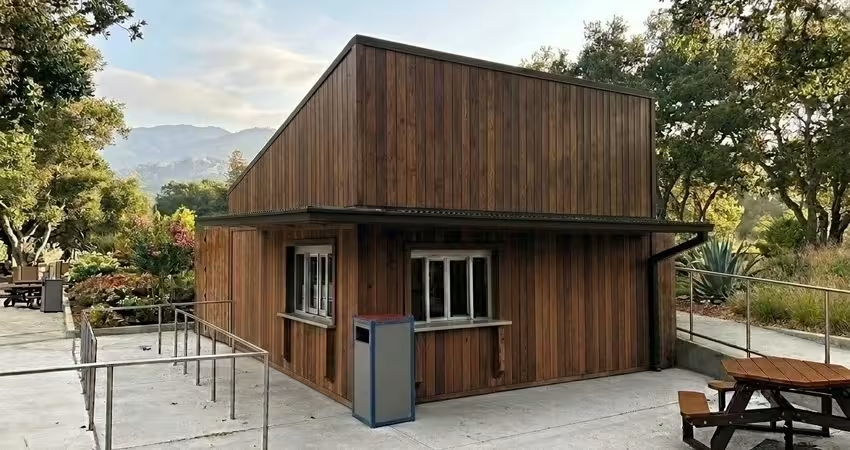
A relocatable container kitchen can protect dining continuity during a broader renovation without the full capital ask upfront, the approach Front Porch took (see our Front Porch case study). Our guide to replacing an aging senior living kitchen covers that decision, and our complete guide to modular kitchens for senior living covers the category.
The Objections Your Capital Committee Will Raise
Three objections come up almost every time a modular kitchen reaches a capital committee: cost perception built on figures misread as a senior-living promise, quality compared against a traditional build, and financing or down-payment structure. Two have a clean, sourced response ready today; the third stays genuinely open.
"Modular Costs More Than It Looks Like on Paper"
This usually traces back to the Apogee and Boyne figures being misread as a single promised number, when they're cross-vertical proof of category savings, not a senior-living-specific guarantee. Bring the line-item table, not the headline percentage. Then add the part the percentage leaves out: a factory build also closes up to 50% faster than a traditional one, so the committee's capital isn't sitting locked in a project for an extra construction season.
"Is Modular Construction the Same Quality as a Traditional Build?"
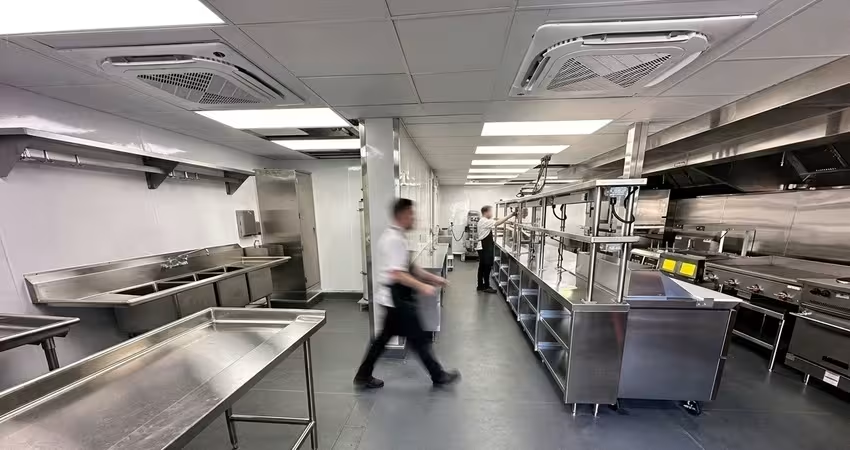
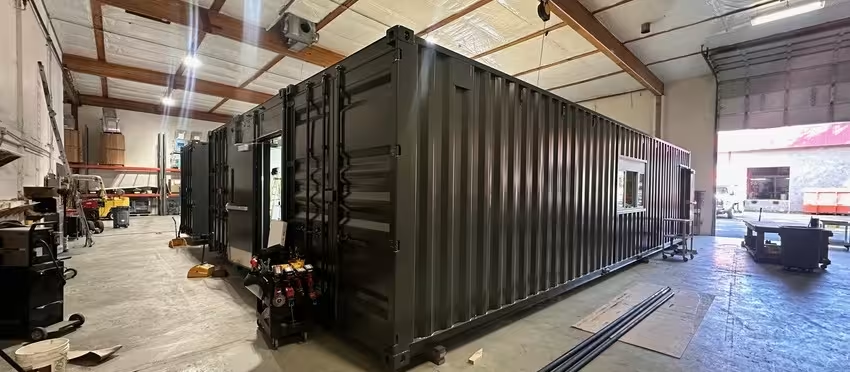
Yes, and this one has a straightforward answer. A permanent modular kitchen is factory-built to commercial-grade, steel-frame construction, built to the same International Building Code standard as a site-built kitchen, and third-party inspected before it ever leaves the plant. The quality gap committees worry about runs the other way: a single factory line under one roof produces more consistent workmanship than a site build coordinating multiple trades and contractors.
"How Do We Finance the Down Payment?"
This stays open. Financing and down-payment structure for a modular kitchen purchase is a real friction point with no standing answer across every committee's lending relationship. Raise it early with your own CFO and lender rather than assuming it works like a traditional construction loan draw schedule.
A Diversified Healthcare Trust earnings call captured the ownership-side version of this math: the REIT expects an incremental NOI of 8% to 10% on invested renovation capital once a property stabilizes (McKnight's Senior Living, 2026). Be ready to answer in that same framing.
Disclaimer
Cost figures, financing terms, and depreciation treatment vary by project, lender, and jurisdiction. The figures above come from named, dated sources and from Modular Culinaire's own verified project history. Confirm your own numbers with your finance team, lender, and tax advisor before finalizing a capital request.

People Also Ask (FAQ)
Does a modular kitchen qualify for the same depreciation treatment as a traditional kitchen build?
Not automatically, and the gap is large. Under IRS MACRS rules, a traditional build folds into the building and defaults to a 39-year depreciation schedule, while a factory-built kitchen classified as tangible personal property can often qualify for a 7-year schedule instead. See our full breakdown of modular kitchen depreciation for the mechanics and the first-year cash-flow math, and confirm the classification with your own tax advisor before building a capital request around it.
How do capital committees evaluate schedule risk on a kitchen project?
Most committees have already been burned by a slipped schedule, so they weight schedule certainty heavily, often more than the headline price. A fixed production timeline running in parallel with site work gives them a date to hold a contractor to, rather than a range with built-in room for slippage.
What does a managed-property owner want to see in a capital request?
Tell us about your kitchen needs and request a quote.

Turnkey prefabricated kitchen
Proudly made in-house in the USA
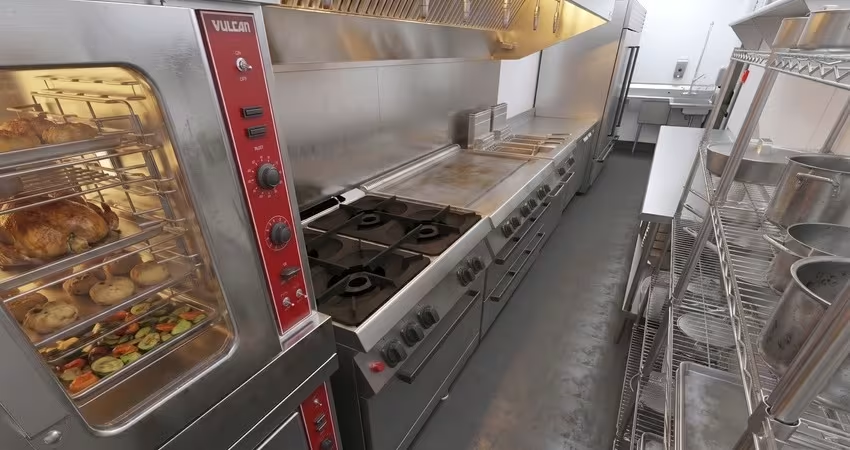
Commercial grade kitchen equipment
Code-compliant
Trusted by Industry Leaders



