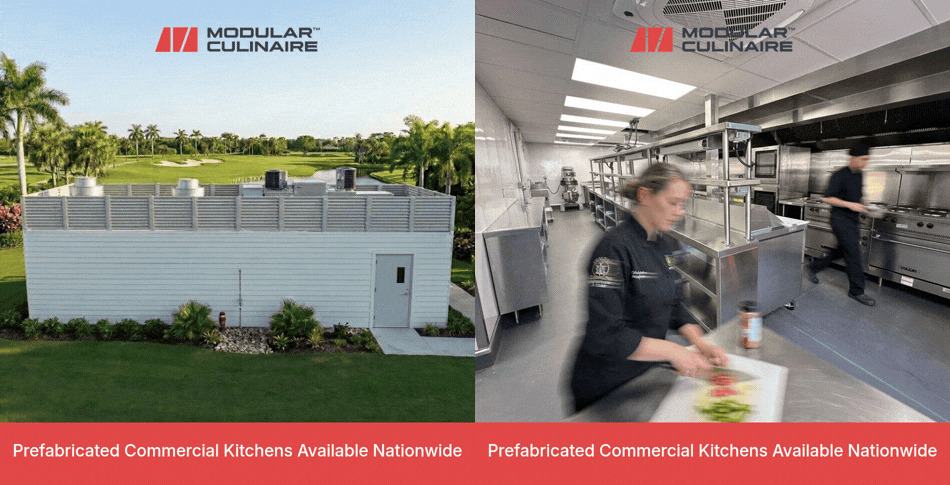
You have a proposal on your desk for a factory-built commercial kitchen. The capital number is roughly 20% below what the board approved for a traditional build, and the schedule shows the unit landing before your next peak season. Before you take it back to the finance committee, they will ask a second question. How does modular kitchen depreciation actually work on the balance sheet, and can you defend the treatment if the auditor comes back?
This article walks through what changes when a kitchen arrives as a manufactured asset, what the 2025 tax rules mean for your first-year deduction, and what your finance team needs to answer.
Why a Prefab Kitchen Sits on the Balance Sheet Differently
A traditional kitchen construction project becomes part of the building. It depreciates over 39 years. A factory-built kitchen, delivered as a pre-assembled unit and set on a prepared foundation, can often be classified as tangible personal property and depreciate over 7 years. Same operating capacity, fundamentally different accounting treatment.
What Depreciation Actually Does
Every capital asset shows up on the balance sheet at its acquisition cost and comes off through depreciation over its assigned useful life. Depreciation itself is a non-cash expense. But the schedule determines when the deduction lands, when the tax shield lands, and the net-present-value picture the board sees.
The useful life assigned to a kitchen depends on how it is classified. A traditional build folds into the building's cost basis and depreciates on the same 39-year schedule as the walls around it. A factory-built module — engineered as a unit and delivered pre-assembled — is a different kind of asset, and the tax code recognises the difference.
Why This Matters for the Capital Decision
That sounds like a technicality, and most operators skip past it. It is not. Over the first decade of ownership it is often the single largest cash-flow variable between the two ways of adding kitchen capacity. Operators evaluating modular kitchens for hotels and resorts look at total cost of ownership rather than sticker price alone.

The 39-Year Default: How a Traditional Build Is Treated
A commercial kitchen built in place as part of a building is capitalised into nonresidential real property. It depreciates straight-line over 39 years. That covers the shell, the structural components, the permanent MEP infrastructure, and anything else the tax code reads as part of the building itself.
How MACRS Sets the Default Class
Under the Modified Accelerated Cost Recovery System (MACRS), commercial building components depreciate straight-line over 39 years. Residential real estate depreciates over 27.5 years, per McGuire Sponsel's MACRS depreciation guide (2025). Land improvements can qualify for 15 years, and certain personal property for 5 or 7 years. But the default for anything inside the four walls of the building is 39 years.
Note: Cost segregation studies can reclassify parts of a building — carpeting, decorative millwork, dedicated kitchen electrical — into shorter-life categories. Per CPCON's 2026 MACRS guide, a cost-seg study can move meaningful portions from 39 years into 5-, 7-, or 15-year classes. Worth mentioning to your CPA, but it operates on top of a build that starts life at 39 years.
What This Looks Like at $1 Million
A $1 million traditional kitchen build generates about $25,641 of depreciation per year for 39 years. At a 21% federal effective rate, that is about $5,385 of tax shield per year. Slow, predictable, and it does little for the first-year budget line.
The 7-Year MACRS Case for Modular Kitchen Depreciation
A factory-built kitchen can often qualify as tangible personal property (TPP) rather than real property. That shifts it into a 7-year MACRS class — less than a fifth of the 39-year building schedule. The classification is not automatic. It turns on how the unit is engineered, how it is affixed, and how relocatable it is in practice.
Real Property vs. Personal Property
The reasoning traces back to how the tax code defines real versus personal property. A structure permanently affixed to land and inseparable from the building is real property. A structure designed as a moveable unit — panelised, pre-assembled, capable of being disconnected and relocated — is more often personal property. Prefabricated buildings designed to be relocatable typically meet the criteria for TPP, per an industry note from the Modular Building Institute (2025). The same logic applies to a factory-built commercial kitchen.
Steel Frame vs. ISO Container
For a hospitality operator, the distinction usually lands one of two ways:
- A steel-frame permanent modular kitchen, engineered as a long-term addition to the property, sits closer to the real-property end. TPP classification is defensible in many cases but usually needs cost-segregation-style documentation and a CPA prepared to make the case.

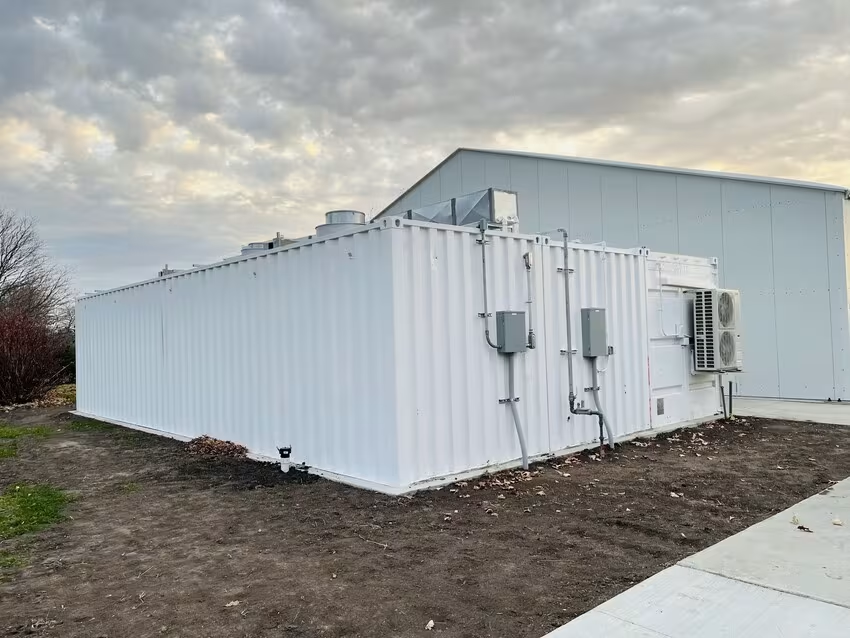
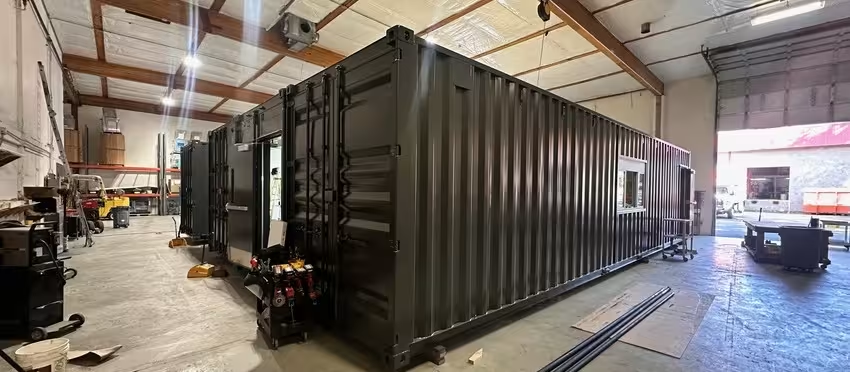
- An ISO shipping-container kitchen, engineered as a semi-permanent or relocatable unit, sits closer to the personal-property end. Because it is designed to be moved and reconfigured, its TPP classification is generally more straightforward.
Note: This is not a determination the manufacturer makes. Classification is a tax position taken by the taxpayer, advised by the CPA, and reviewed by the IRS if examined. The manufacturer's role is to produce supporting documentation — engineering, PE-stamped drawings, inspection reports, relocatability memos. A structural design life of 30 to 50-plus years does not disqualify a steel-frame unit from TPP treatment. Useful life and depreciation class are separate.
Section 179 and 100% Bonus Depreciation: What OBBBA Changed for 2025 and 2026
The One Big Beautiful Bill Act (OBBBA), signed July 4, 2025, permanently restored 100% first-year bonus depreciation for qualifying property placed in service after January 19, 2025. It also raised the Section 179 cap to $2.56 million for 2026. For an operator whose kitchen qualifies as TPP, the full cost can be deductible in year one.
The provision applies to tangible personal property with a recovery period of 20 years or less — including the 7-year modular classification — and covers both new and used property, per DHJJ's OBBBA analysis (2026).
Section 179 and bonus depreciation do overlapping work:
- Section 179 lets you elect to expense qualifying property up to $2.56 million in 2026, with a $4.09 million phase-out threshold, per Bloomberg Tax. It cannot create a net operating loss.
- Bonus depreciation applies automatically unless you elect out. No dollar cap, and it can create or increase an NOL, which carries forward and offsets up to 80% of taxable income in future years, per Reed Corp. (2026).
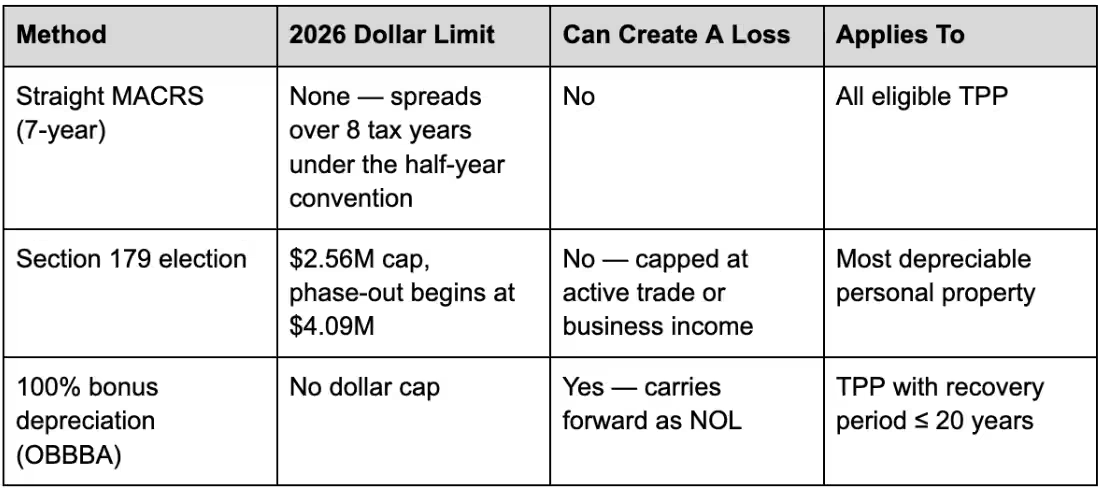
Most operators use bonus first and reserve Section 179 for planning gaps, depending on entity, income, and state.
Tip: Not every state conforms to federal bonus depreciation, and Section 179 is often more portable for multi-state operators, per Bassets. Ask your CPA which regime each state follows.
Who Actually Decides the Classification
The taxpayer files the classification on the tax return. The CPA advises it. The IRS reviews it if the return is examined. The manufacturer's role is not to make the call — it is to provide the engineering, inspection, and relocatability documentation supporting whatever position the CPA takes.
For a board that has never approved a factory-built kitchen before, "we think it depreciates over 7 years" is not a defensible answer. A defensible answer sounds different: our tax adviser has reviewed the engineering and foundation documentation, recommended a classification, and told us what a first-year deduction of $X looks like on this year's return. That answer needs three things behind it.
- Engineering and structural documentation: Signed and sealed drawings, foundation specs, utility-connection details. A CPA making a TPP argument leans on how removable the affixation is.
- Third-party inspection and code compliance: IBC certification, HUD tags where applicable, pre-shipment inspection reports. These establish the unit as a factory-controlled asset.
- A relocatability memo: A concise document describing how the unit can be disconnected, transported, and reinstalled. The single most useful piece of paper for a CPA arguing personal-property.
Tip: Ask the manufacturer to commit to the full documentation package before you sign, with named individuals for each piece. Modular Culinaire supplies signed and sealed drawings via a client portal and third-party inspection records — our team can walk your CPA through the set that supports the classification.
Ten-Year Cash-Flow Picture: A Side-by-Side Comparison
For a $1 million kitchen project at a 21% effective federal tax rate, the difference between the 39-year real-property schedule and 7-year TPP with 100% bonus depreciation is roughly $205,000 of first-year tax shield. The modular treatment pulls almost the entire deduction forward; the traditional build spreads it across four decades.
The table below models both treatments on a $1 million kitchen placed in service in 2026. It ignores discount rate, state tax, and any Section 179 election. Numbers vary by entity, state, and the classification your CPA supports.
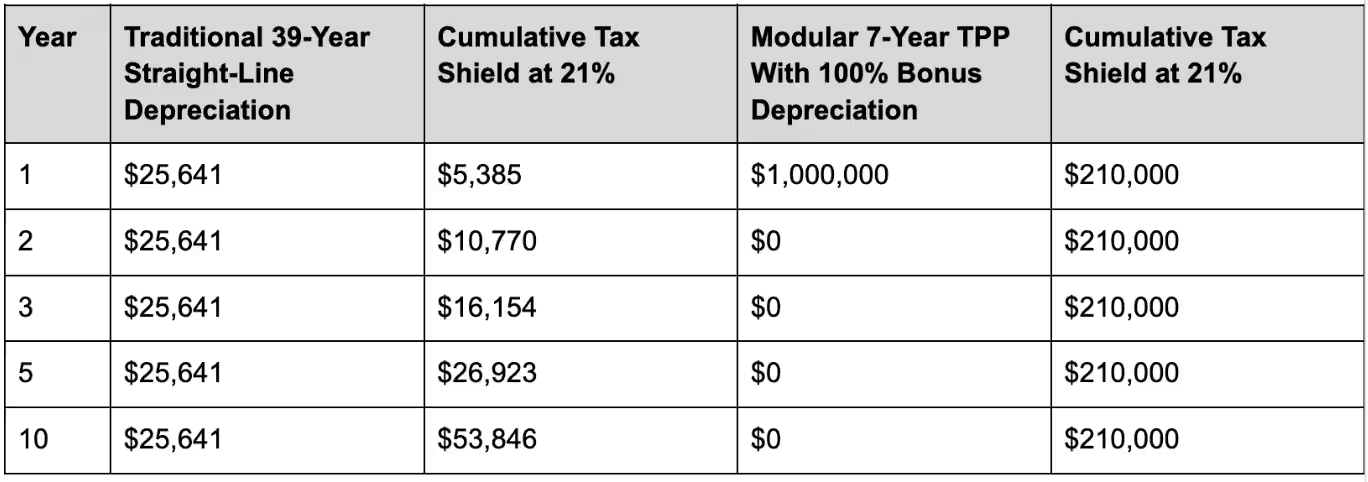
Two points for the board meeting. The modular treatment does not increase the total deduction — same $1 million recovered, just on a different curve. And the timing matters because the first-year deduction is often available in the same year the operator absorbs the capital outlay.
This stacks on top of the up-front capital saving typical on a modular project. Modular Culinaire's Boyne Resorts project saved roughly 30% versus traditional construction on a 640-square-foot QSR kitchen at Brighton, UT. Operators evaluating the container-versus-brick-and-mortar comparison look at both effects together.
Building the Board Case: Three Questions to Answer Before You Present
Before the finance committee meeting, the GM should be able to answer three questions from the tax adviser in writing. Getting these into the packet before the vote is the difference between defending the decision cleanly and re-opening it later.
- What is our tax adviser's classification recommendation for this project? A written recommendation from the CPA who signs the return, tied to the engineering and foundation package for the unit — not the manufacturer's, not a general industry note.
- Which first-year deduction path fits our income position — bonus, Section 179, or straight MACRS? The answer depends on entity structure, taxable income, state conformity, and whether an NOL carryforward helps or hurts. All three paths are legitimate — only one is optimal in a given year.
- What documentation does the manufacturer commit to providing, and by when? Signed and sealed drawings, foundation specs, third-party inspection reports, and a relocatability memo — each with a named individual and a delivery date tied to the schedule.
The modular case is easier to defend when the classification, the deduction path, and the paper trail are in the packet — one reason hospitality operators evaluate modular kitchens on total cost of ownership.
Conclusion
The 20% capital saving gets a modular kitchen project a first hearing at the board. Modular kitchen depreciation is often what gets it approved. A kitchen classified as tangible personal property under a 7-year MACRS schedule — with 100% bonus depreciation under OBBBA — moves roughly $205,000 of first-year tax shield forward on a $1 million project. Build the packet before the vote.
Disclaimer
This article describes general US federal tax treatment under MACRS and the One Big Beautiful Bill Act of 2025 as of publication. It is not tax, legal, or financial advice. Classification of a specific asset, election of a specific depreciation method, and treatment under state income tax rules depend on facts and circumstances particular to each taxpayer. Consult a qualified tax adviser before making any capital-project decision on this basis.
People Also Ask (FAQ)
What is the depreciation life of a modular building?
Under MACRS, a modular building can qualify for either 7-year tangible personal property treatment or 39-year nonresidential real property treatment. The classification turns on whether the structure is engineered as a moveable, panelised unit or permanently affixed in a way inseparable from the building, and on how the taxpayer's CPA documents that position.
Can I use Section 179 or bonus depreciation on a modular kitchen?
If the unit qualifies as TPP with a recovery period of 20 years or less, both Section 179 (up to $2.56 million in 2026) and 100% bonus depreciation are available under OBBBA. Most operators use bonus depreciation first for its no-dollar-cap advantage and reserve Section 179 for planning gaps or where an NOL is unhelpful.
Is a permanent modular kitchen real property or personal property for tax purposes?
The classification is fact-and-circumstances specific. A steel-frame permanent modular kitchen affixed to a foundation can be defensible as personal property, but the position requires cost-segregation-style documentation and a CPA prepared to support it on the return. An ISO container kitchen designed to be relocated has a more straightforward personal-property case.
How does the 7-year MACRS schedule compare to the 39-year building schedule?
The 7-year schedule recovers the full cost basis over eight tax years under the half-year convention, front-loaded into the early years. The 39-year straight-line schedule spreads about 2.56% of the basis across each year for nearly four decades. On a $1 million asset, the timing difference is worth several hundred thousand dollars of net-present-value tax shield.
Who decides whether my modular kitchen qualifies for accelerated depreciation?
The taxpayer files the position on the return, advised by the CPA who signs it. The IRS reviews the position if the return is examined. The manufacturer's role is to supply engineering, third-party inspection, and relocatability documentation that supports the CPA's recommendation — the manufacturer does not make the classification itself.
%2520(1).jpeg)
Tell us about your kitchen needs and request a quote.

Turnkey prefabricated kitchen
Proudly made in-house in the USA
Commercial grade kitchen equipment
Code-compliant
Trusted by Industry Leaders



