If you manage dining services, the kitchen answers to more than one inspector: the state agency that licenses your community, the local or state health department running the food code, and, only if you also operate skilled nursing, the Centers for Medicare & Medicaid Services (CMS). When you're building or replacing a kitchen, each of those intersects with your project timeline differently, and none of them work exactly like the restaurant-permit process most people assume applies.
Here's what an assisted living kitchen compliance review actually checks, where plan review sits in your schedule, how requirements differ by state, and what documentation to request from any manufacturer before you commit to a design.

Who Actually Regulates Your Kitchen, and It's Not Always Who You Think
Your kitchen can fall under three regulators depending on facility type: the state agency that licenses assisted living, the state or local health department enforcing the food code, and, for skilled nursing only, CMS. Which one leads plan review sets your timeline and who signs off before you open.
Why This Matters for Your Compliance Record
For your role, the stakes aren't abstract: a failed or delayed kitchen review becomes a citation on the compliance record you own, not just a construction delay on someone else's schedule.
How States Combine, or Separate, These Reviews
Many states fold assisted-living food service directly into the facility license rather than treating it as a separate restaurant permit. Minnesota is the clearest example: its Assisted Living Licensure (ALL) program, effective August 1, 2021 under Minnesota Statute Chapter 144G, moved kitchen inspection into the same survey as the facility license. The state's licensing division now handles plan review for new kitchens, while a separate environmental-health division enforces the Minnesota Food Code.
Oregon takes a narrower approach: ORS 443.417 requires an annual kitchen inspection as a standing license condition, separate from one combined survey. New Mexico licenses assisted living under Title 7, Chapter 8, Part 2 of its administrative code, addressing kitchen sanitation in its own section (7.8.2.36) alongside the general licensing rule.
Where Skilled Nursing Differs
That's a real distinction from skilled nursing, where CMS requires an authorized food-safety inspection for any kitchen, including an off-site one, serving Medicare- or Medicaid-certified residents. Most assisted living communities aren't CMS-certified for dining, so that federal layer typically doesn't apply. Assuming either "restaurant rules" or "nursing-home rules" misses what actually governs an assisted living kitchen.
What an Assisted Living Kitchen Compliance Review Actually Checks Before You Open
A state review typically runs in three phases: plan review during design, a pre-opening inspection before residents are served, and recurring inspections once you're operating. Each phase checks different things, and missing the first one is what causes the most expensive delays.
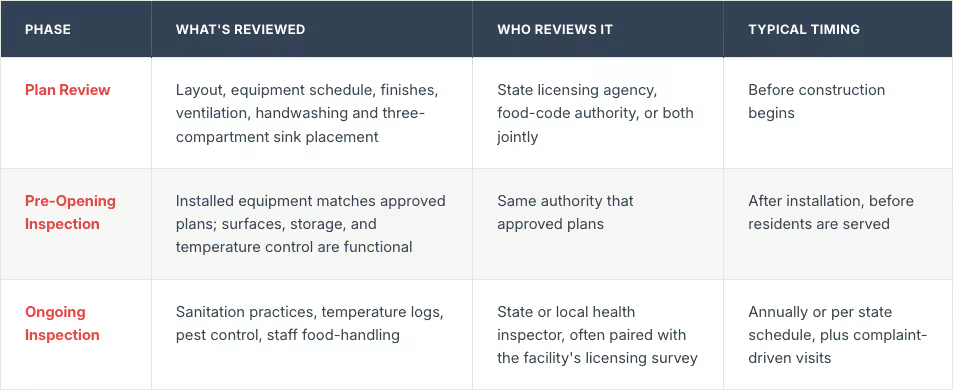
Note: Plan review is the phase operators most often skip or treat as a formality. It's the one point where a design change is cheap. After installation, the same change means demolition.
Tip: Ask early which single agency has jurisdiction over your kitchen's plan review. In states that fold food service into the facility license, that may not be the same office that handles your building permit.
How Requirements Differ by State
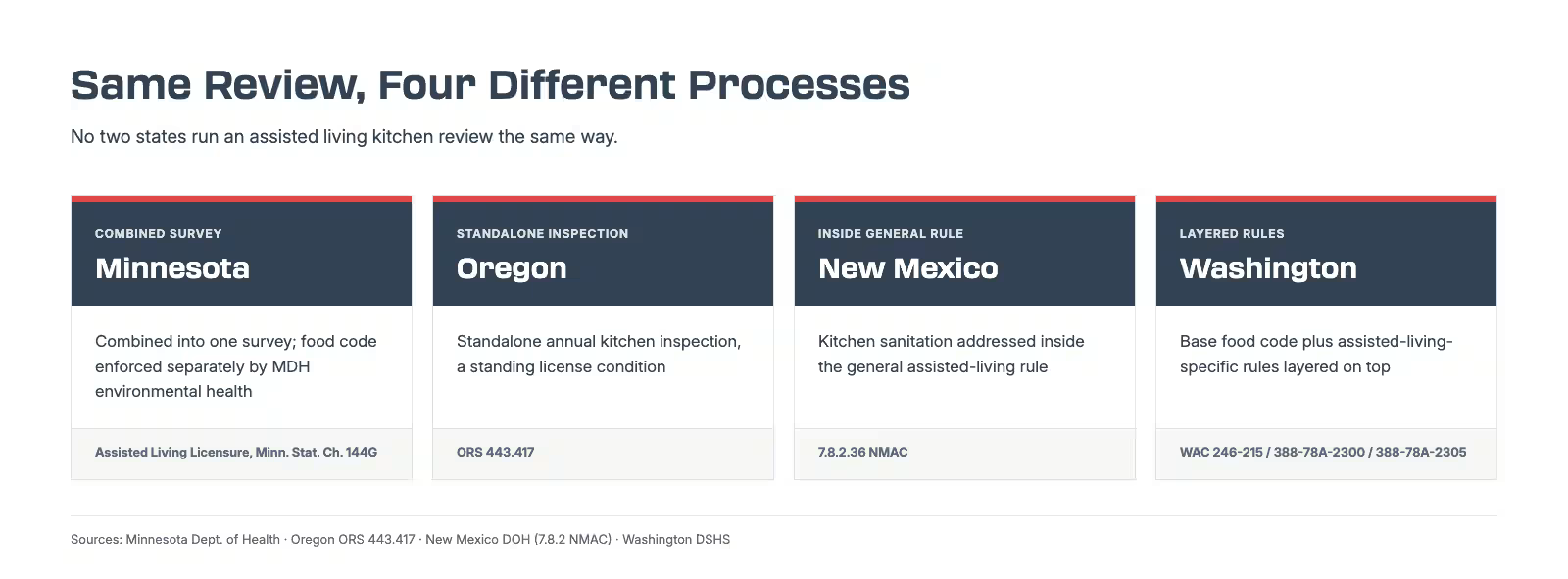
The agency, the timeline, and even the name of the review change by state. Minnesota combines licensing and food inspection into one survey; Oregon requires a standalone annual kitchen inspection; New Mexico and others address kitchen sanitation inside the general assisted-living rule. None of this is standardized nationally.
What a Factory-Built Kitchen Changes, and What It Doesn't
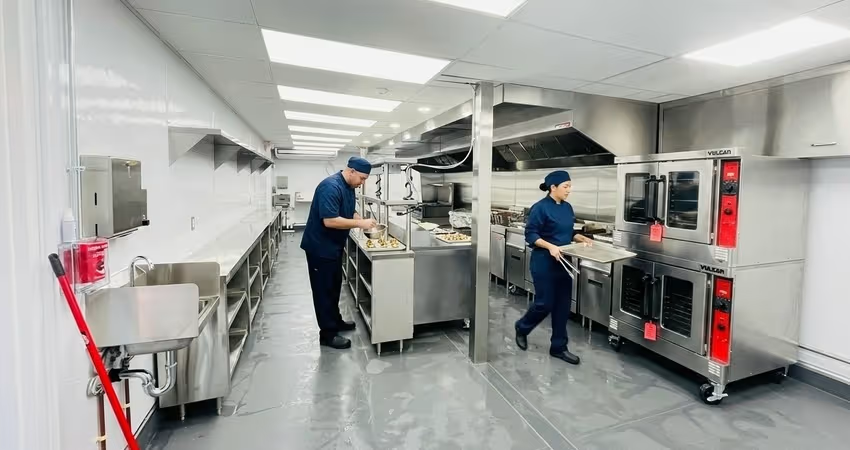
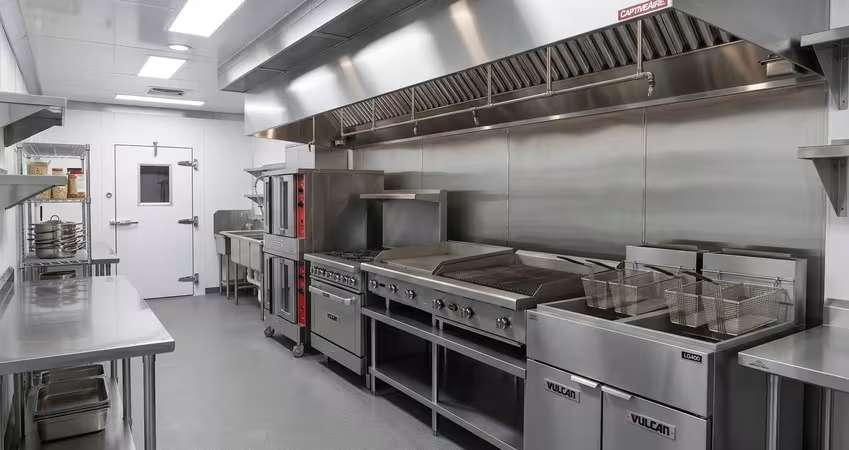
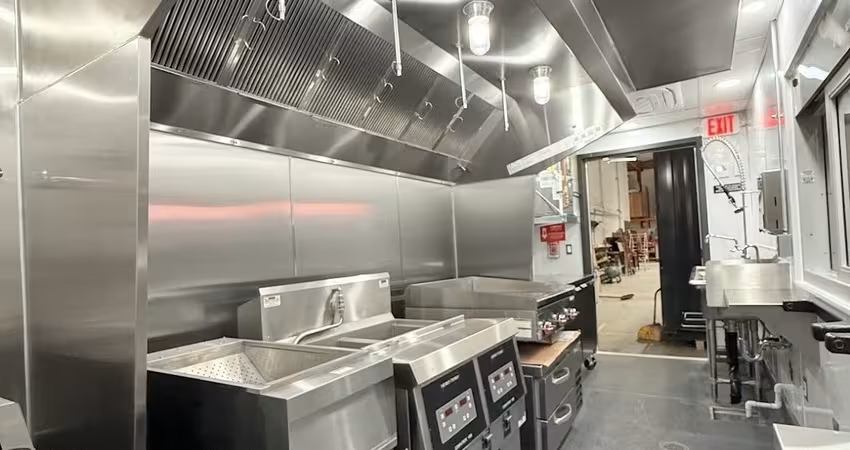
This is where a factory-built kitchen earns its reframe. A site-built kitchen generates its documentation piecemeal, as each trade finishes its own work, often with gaps a reviewer has to chase down. A kitchen manufactured off-site and inspected by a third party before it ever reaches the site arrives with one complete, consistent documentation set: PE-stamped drawings, equipment specifications, and inspection records the reviewer can check against the room in front of them.
That's a different thing from a guarantee that any manufacturer's general compliance record extends to your state's specific assisted-living or food-sanitation rule. It doesn't, automatically, and no manufacturer should imply that it does. What it does is give the person managing your review a complete, defensible packet to start from, rather than a stack of partial submittals.
Modular Culinaire's building-permit approval record (100% to date, across the states it has built in) speaks to the building-permit side of construction. It isn't a substitute for confirming, state by state, how your assisted-living licensing agency treats kitchen plan review specifically. That confirmation is still yours, or your reviewer's, to make.
Documentation to Request From Any Manufacturer
Before you commit to a design, ask for signed-and-sealed drawings, third-party inspection reports, equipment NSF/UL listings, and a written answer on which state agency the manufacturer expects to review your kitchen. A manufacturer that can't produce these isn't ready for a licensed facility.
This is the same packet Modular Culinaire assembles for every unit before it leaves the factory, and it's a reasonable baseline to hold any manufacturer to, whether or not you build with us. Ask for, in writing, before you sign:
- PE-stamped structural and MEP drawings for your specific unit, not a generic model sheet.
- Third-party inspection reports from the factory build, with the inspecting agency named.
- NSF/ANSI or UL listings for every piece of installed equipment.
- A written statement of which state or local agency the manufacturer expects will review your kitchen, and whether that differs from the agency reviewing your building permit.
- References from at least one prior assisted living or senior living installation, if one exists, so you can ask that operator how their state's review actually went.
Tip: If a manufacturer can't name which specific agency reviews their kitchens in your state, that's a sign the confirmation hasn't been done yet, not that it doesn't matter.
How to Avoid a Rework Cycle During Plan Review
Loop your state's licensing or health authority into the kitchen design before equipment is ordered, not after. A short pre-submittal call to confirm jurisdiction and the required documentation set costs you ten minutes. A change order after plan review rejects a finished layout costs far more, in both money and schedule.
Three things shorten the cycle: confirm which agency has final sign-off before design starts, submit the full documentation set in one pass instead of piecemeal, and stay in the room for reviewer questions about meal counts and service times. A general contractor or architect can't answer those, and reviewers ask them more often than operators expect.
The Bottom Line
An assisted living kitchen compliance review isn't one inspection; it's a sequence that starts at plan review and continues as long as you operate, run by whichever state agency your jurisdiction assigns, in whatever order that state has set up. Confirming who reviews what, and requesting complete documentation from your manufacturer before you design around it, is what keeps that sequence from turning into a rework cycle.
Before you finalize a kitchen design, request a documentation review and get a straight answer on what your state's assisted-living review will actually require.
Disclaimer
Kitchen plan review and inspection requirements vary by state and, in some cases, by county or municipality, and the rules referenced above may have been revised since publication. Confirm current requirements with your state's assisted-living licensing agency and your local authority having jurisdiction before finalizing a kitchen design.
People Also Ask (FAQ)
Does a new assisted living kitchen need a separate inspection from the building permit?
Usually, yes. A building permit confirms the structure meets building code; it doesn't confirm the kitchen meets food-sanitation or assisted-living licensing rules. Depending on your state, that second review may come from a separate food-code authority or be folded into your facility's licensing survey, so confirm both with your local jurisdiction before assuming one covers the other.
Is an assisted living kitchen inspected the same way as a restaurant kitchen?
Not exactly. Many states apply the same base food code to both, but assisted living facilities also carry licensing-specific rules, such as meal-service timing and staff training requirements, that a standalone restaurant inspection wouldn't check. Some states, like Minnesota, fold both reviews into one survey rather than running them separately.
How long does kitchen plan review take for a senior living community?
It varies by state and by how complete the initial submittal is. A documentation set that's missing equipment specs or inspection records typically adds the most delay, since the reviewing agency has to request it and wait before continuing. Submitting a complete package in the first pass is the single biggest factor operators control.
Who inspects an assisted living kitchen after it opens?
Ongoing inspections typically come from the same state or local health authority that handled food-code enforcement before you opened, often on an annual schedule plus complaint-driven visits. In states that combine licensing and food inspection into one survey, this may be the same inspector who handles your facility's broader licensing renewal.

Tell us about your kitchen needs and request a quote.

Turnkey prefabricated kitchen
Proudly made in-house in the USA
Commercial grade kitchen equipment
Code-compliant
Trusted by Industry Leaders



